
Chimney Cleaning vs. Inspection: Which Service Do You Need?
A chimney cleaning removes deposits and debris. A chimney inspection evaluates condition. Depending on why you are booking, you may need one service, both services, or an inspection followed by cleaning only if the findings call for it.
| Your situation | Likely starting point | What the visit should answer | What to confirm |
|---|---|---|---|
| Routine annual check; no major change | Usually a Level I inspection; sweep if conditions indicate | Current accessible condition and whether cleaning is needed | The inspection level, included flue and appliance, and how findings are delivered |
| Known soot, creosote, or debris concern | Initial check plus cleaning if authorized and needed | What the material is, whether it can be removed, and what is visible afterward | Cleaning scope, difficult deposits or blockage work, and the post-clean check |
| Buying or selling a home | Level II inspection | Documented condition for the transaction | Which fireplaces, appliances, chimneys, and flues are covered |
| Changing an appliance, fuel, or chimney lining | Inspection matched to the proposed change; often Level II when relevant conditions change | Whether the existing system and venting suit the proposed work | Who evaluates sizing, connections, and relevant accessible areas |
| Suspected chimney fire | Stop use and arrange an appropriate inspection, usually Level II first | Evidence of possible damage and what is needed before reuse | Relevant evidence is documented before cleaning begins |
| Storm, impact, or other potentially damaging event | Inspection level based on the event and evidence; Level II when the event was likely to cause damage | Whether the event affected the chimney or venting | Why the recommended level fits this event |
| Deposits obscure part of the liner | Document what is visible, clean as authorized, then examine the newly visible surface | The condition of the area that buildup had hidden | The exact obscured area, cleaning scope, recheck, and remaining limits |
| Gas appliance or vent concern | Inspection or service suited to that appliance and vent; cleaning only if conditions require it | Blockage, corrosion, connection, venting, and appliance concerns | The company works on that system and whether appliance service is separate |
| Service history is uncertain | Start with an inspection chosen after the company understands the system and circumstances | Current condition and whether cleaning or broader inspection is indicated | Why Level I or Level II fits; unknown history alone does not decide the level |
This table is a booking guide, not a diagnosis. Describe why you are calling and any change, symptom, fire, or impact before the company recommends a scope.
What does chimney cleaning do?
Cleaning—also called sweeping—physically removes appropriate deposits, loose material, debris, or certain obstructions from the areas included in the job. It can restore visibility where soot or creosote covers a surface, but it does not repair damage or prove the liner, masonry, appliance connection, or concealed construction is sound.
The result depends on the deposit and the agreed scope. Loose soot and removable creosote may respond to ordinary sweeping; hard glaze, a blockage, or difficult access can require different work. The full chimney cleaning guide explains what professional sweeping removes and what may be priced separately.
What does chimney inspection check?
An inspection evaluates the accessible condition of the chimney, flue, connected appliance or fireplace, and other areas included in the selected level. It may document deposits, blockages, damage, venting concerns, or access limits. It does not remove deposits or repair what it finds.
The inspection level matters because it defines why the work is being done and how far the examination goes. A routine unchanged system usually starts differently from a home sale, an appliance change, or possible damage. Use the Level 1, Level 2, and Level 3 comparison for the complete decision guide.
An inspection can reasonably end with the finding that sweeping is not currently indicated. That means the observed deposits or obstructions did not call for cleaning within the inspection scope; it is not a promise that every concealed area is free of defects.
Does a chimney sweep include an inspection?
It may, but the word “sweep” alone does not tell you the inspection level, areas checked, or documentation you will receive. Ask the company to name the inspection scope before you compare prices.
CSIA’s dated procedures connect Level I work with routine cleaning: its masonry procedure recommends Level I during routine cleaning, and its factory-built procedure says the Level I objective is included with each sweep job. Those procedures help explain professional practice, but they do not prove that every advertised sweep includes a formal Level I today. See the masonry Level I procedure and factory-built Level I procedure.
A technician may notice an obvious crack or obstruction while brushing. That observation is useful, but it does not establish that every area in a defined inspection was examined. Ask which flue and appliance were inspected, which level was completed, what could not be seen, and whether you will receive photos or written findings.
When do cleaning and inspection happen together?
They often happen together during routine maintenance when the correct starting scope is a Level I inspection and removable deposits are present. They also work as a sequence when an initial check finds that buildup is hiding a surface that needs examination.
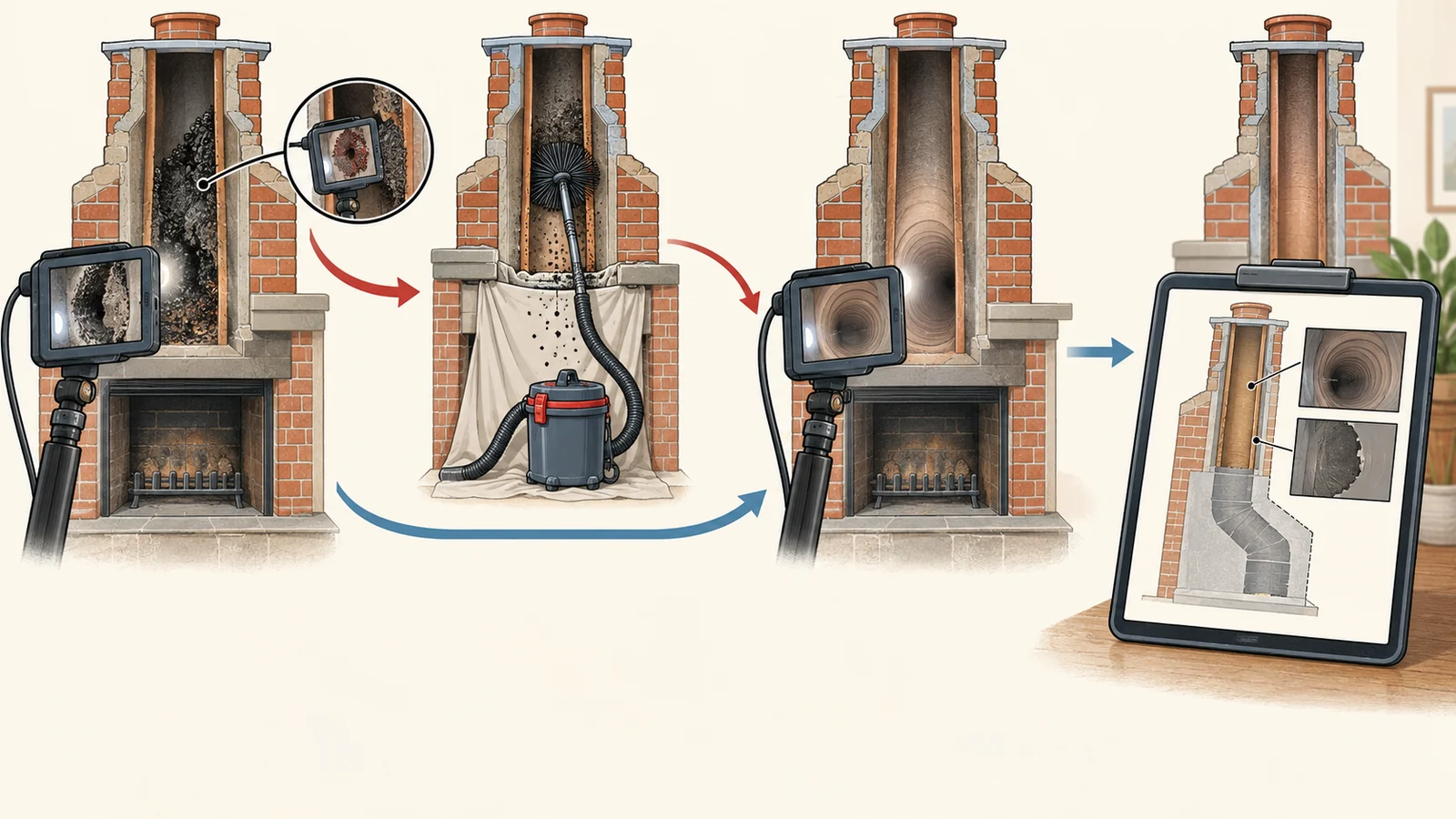
- Evaluate and document
- Clean only if needed
- Recheck visible areas
- Report findings and limits
CSIA’s Level I masonry procedure describes an initial inspection before sweeping and a later look at the liner when deposits had blocked the view. The practical sequence is: evaluate and document, clean if authorized and needed for visibility, examine the newly visible surface, then report findings and remaining limits.
If the initial view is adequate and cleaning is not indicated, the professional can bypass the cleaning step and continue the inspection. Cleaning can reveal a deposit-covered surface; it cannot expose a liner exterior behind a wall or another concealed area.
Should inspection or cleaning happen first?
The professional should first identify the system, understand why you are booking, and document relevant conditions. Cleaning comes next only when deposits or debris need removal. The newly visible areas should then be evaluated before the final findings are issued.
This does not always require separate appointments. A company can perform the initial check, authorized cleaning, and post-cleaning evaluation during one visit when the scope, equipment, and time allow. Confirm what happens if the technician discovers work outside the original quote.
If a chimney fire is suspected
Stop using the system and tell the professional before work begins. Evidence such as unusual deposits or heat damage may need to be photographed before sweeping disturbs it. The CSIA masonry procedure directs technicians to document indications of a chimney fire before sweeping and recommend a Level II inspection; CSIA’s post-fire guidance also explains why cleaning alone cannot establish the absence of damage.
Can a chimney be too dirty to inspect?
Deposits can obscure part of the liner enough that its condition cannot be fully evaluated until cleaning occurs. That does not make every part of the chimney unknowable. The report should identify the exact area, the visibility problem, and the plan to complete the affected part of the inspection.
Ask which surface could not be seen, what material caused the limitation, whether cleaning is included, and whether the area will be checked again afterward. If deposits remain, the chimney bends out of view, or construction is concealed, those limits should remain in the final findings.
Is Level I enough, or should I ask about Level II?
Level I is generally the routine starting point when the appliance, fuel, venting, and use have not significantly changed. Level II is generally associated with a home transfer, a relevant system change, possible damage, or a Level I that cannot answer the concern.
Routine use with no significant changes
A Level I inspection focuses on defined accessible areas for continued use under routine conditions. The CSIA Level I procedure includes cleanliness and blockage among the conditions evaluated. It is more than a quick glance while the brush is moving.
A home sale, system change, or possible damage
The CSIA Level II procedure describes broader circumstances and accessible areas, along with internal video scanning or a similar examination. If a suspected hazard cannot be evaluated without access to a concealed area, targeted Level III work may be considered; the CSIA inspection-level overview provides historical context. Ask the inspector to explain why the selected level fits your situation rather than treating a higher number as a generic upgrade.
Does annual inspection mean annual cleaning?
No single wording covers every system. Arrange regular professional inspection or maintenance and follow the instructions for your fireplace, stove, vent, or chimney. Whether sweeping is needed depends on the system and what the professional finds.
CSIA’s homeowner guidance separates annual inspection from cleaning when deposits or conditions make sweeping necessary. The U.S. Fire Administration uses a broader public-safety reminder to have chimneys professionally cleaned and inspected each year. These are different formulations, so do not turn them into a claim that every chimney has the same cleaning schedule.
The Consumer Product Safety Commission also recommends yearly professional inspection of fuel-burning home heating systems, including chimneys, flues, and vents. Your actual work plan should still account for fuel, use, deposits, obstructions, system design, and manufacturer instructions. The chimney-cleaning frequency guide explains how those factors change the schedule.
Does a camera make it Level II?
No. A camera is an inspection tool, not an inspection level. Adding a flue scan to a routine visit does not by itself expand the accessible areas, circumstances, and other work that define Level II.
CSIA’s dated Level I procedure makes video scanning optional at Level I, while its Level II procedure includes internal video scanning or a similar examination. Ask which level is being performed, which flues will be scanned, whether the recording or still images are included, and what could not be seen.
A camera can examine the visible interior surface within its path. It cannot see through a liner, wall, chase, or other concealed construction. Cleaning may improve its view of a deposit-covered surface, but it does not remove those physical access limits. See the full inspection-level comparison for the differences in access, imaging, and limitations.
How to compare “sweep with inspection” quotes
Compare the work described, not the bundle name. Two quotes can use the same phrase while covering different flues, inspection levels, camera work, reports, and follow-up.
| Quote detail | Ask this | Why it matters |
|---|---|---|
| System included | Which fireplace or appliance, chimney, and flue does this price cover? | One chimney can have multiple flues, and a quote may cover only one. |
| Inspection scope | Which inspection level is included, and why does it fit my situation? | “Visual” or “basic” does not define the areas examined. |
| Cleaning scope | Which areas will be swept, and what happens with hard deposits or a blockage? | Ordinary sweeping may not cover every deposit or removal task. |
| Camera use | Will you scan the full accessible flue, and are images or video included? | A camera is a tool; it does not establish Level II by itself. |
| Post-clean check | If buildup hides a surface, will you inspect it after cleaning? | Visibility is the reason for the cleaning-inspection sequence. |
| Deliverable | Will I receive findings, photos, limitations, and next steps in writing? | A cleaning receipt alone may not explain the chimney’s condition. |
| Limits and escalation | What could not be reached or seen, and what finding would change the inspection scope? | You need to know when another inspection level or targeted access would require approval. |
| Additional work | What requires my approval and a separate price? | Special deposit removal, extra flues, access, or another inspection level may be separate. |
What work and inspection are included?
Ask which flues will be examined, which inspection level will be completed, which areas will be cleaned, and what report you will receive. If the company cannot name a formal level, have it describe the actual areas, tools, limits, and deliverable in writing.
What happens if more work is needed?
Ask the inspector to show the affected area and explain what concern needs investigation. A repair estimate alone is not an explanation of the inspection findings. You should be able to separate what was observed, what remains uncertain, and what next step would answer that uncertainty.
Questions to ask before booking
Use these questions to define the appointment before anyone arrives. Keep the answers with the quote so you can compare them with the final report.
- Which fireplace or appliance, chimney, and flue are included?
- Am I booking cleaning, a named inspection level, or both?
- Why does that inspection level fit the reason I am calling?
- If deposits hide a surface, is cleaning included and will that area be checked afterward?
- Is camera scanning included, and which flues will be scanned?
- What findings, photos, limitations, and next steps will I receive?
- What work requires separate approval or a separate fee?
- If you find possible fire damage or another urgent concern, should the system remain unused?
Choose the service that answers your concern
Book around the question you need answered. If the concern is deposits or debris, cleaning may be part of the job. If the concern is condition, change, damage, or unknown history, start with the appropriate inspection. When both are needed, make sure the quote includes the initial evaluation, authorized cleaning, post-cleaning check, and clear findings.
General information, not an inspection or diagnosis. Confirm your situation with a qualified professional.
Sources and further reading
CSIA homeowner resources: annual inspection and condition-based sweeping
CSIA Level 1 masonry chimney inspection procedure (2019 PDF)
CSIA Level 1 factory-built fireplace inspection procedure (2019 PDF)
CSIA Level 2 masonry chimney inspection procedure (2019 PDF)
CSIA explanation of the three inspection levels (2000 historical overview)
CSIA: What to know after a chimney fire