
How Often Should a Chimney Be Cleaned?
Plan on a professional chimney inspection or maintenance visit at least once a year. Cleaning is needed when deposits, debris, an obstruction, the system’s instructions, or the professional’s findings call for it. Some wood-burning systems need another check during the heating season.
| Your system or situation | Practical starting point | What decides the cleaning |
|---|---|---|
| Masonry wood-burning fireplace | Yearly professional inspection; sweep when the condition calls for it | Deposits, glaze, debris, obstruction, use, and what the professional can see |
| Factory-built wood fireplace | Yearly professional inspection and maintenance based on its manual | Any appreciable buildup under CSIA guidance, plus the listed system’s instructions |
| Wood stove or insert used often | Yearly service plus checks during the season when the manual or past buildup supports them | Use, wood moisture, operation, chimney temperature, deposits, and the appliance manual |
| Gas or oil appliance vent | Yearly professional appliance and vent inspection | Soot, debris, corrosion, blockage, vent design, and manufacturer instructions—not a wood-creosote formula |
| Unknown history or long disuse | Inspect before relying on a calendar interval | The identified system and its present condition |
| Smoke, falling debris, a major draft change, or a suspected chimney fire | Arrange prompt evaluation; stop use when a fire or substantial smoke entry is suspected | The cause must be identified before assuming routine sweeping is enough |
This table is a planning guide, not a determination that your chimney is ready to use. Follow the instructions for the actual fireplace, stove, insert, appliance, chimney, or vent.
Does a chimney need to be cleaned every year?
Not every chimney needs identical sweeping work every year. A yearly professional inspection or maintenance visit is the useful baseline because that visit can identify deposits, debris, blockage, deterioration, or a system-specific reason to clean. Many wood-burning systems do need annual cleaning, and some need another check sooner.
The calendar starts the maintenance conversation; it does not show what is inside the flue. CSIA’s homeowner guidance separates annual inspection from cleaning when deposits or conditions make it necessary. If a professional finds no removable buildup or obstruction that warrants sweeping, “cleaning is not presently indicated” can be a reasonable finding.
That finding applies to the observed system and time of the inspection. It does not guarantee that every concealed area is sound, and it does not cancel the next inspection or maintenance interval in the system’s instructions.
For what sweeping actually removes and what a cleaning visit should include, use the professional chimney cleaning guide.
Why do CSIA and USFA sound different?
The two organizations use different kinds of guidance. CSIA explains annual inspection with condition-based sweeping. The U.S. Fire Administration gives a broader public-safety reminder to have heating equipment and chimneys professionally cleaned and inspected each year.
| Source | What it says | How to use it |
|---|---|---|
| CSIA homeowner guidance | Inspect at least annually; clean, maintain, or repair as needed, with separate buildup guidance by system | Use the actual deposits, obstruction, system, and findings to decide the sweeping work |
| U.S. Fire Administration | Have heating equipment and chimneys cleaned and inspected each year by a professional | Treat it as a broad annual fire-safety maintenance reminder |
| Consumer Product Safety Commission | Arrange yearly professional inspection of fuel-burning systems, including chimneys, flues, and vents | Keep inspection in the plan even when wood-style sweeping is not relevant |
The practical answer is to arrange professional evaluation or maintenance at least yearly, follow the actual system manual, and ask what condition or instruction supports the cleaning recommendation. Do not turn the source wording into a claim that every chimney receives the same service on the same date.
If you are comparing a bundled appointment, Cleaning vs. Inspection explains what each service answers and what to confirm in the quote.
How often should different fireplaces and vents be cleaned?
Start by identifying the fireplace or appliance, fuel, chimney or vent, and manufacturer. A masonry fireplace, factory-built fireplace, wood stove, pellet appliance, and gas vent should not inherit one generic sweeping rule.
| System | Inspection or maintenance baseline | Cleaning decision |
|---|---|---|
| Masonry wood-burning fireplace | Professional inspection at least yearly | CSIA recommends sweeping at 1/8 inch of sooty buildup and sooner if any glaze is present; actual findings and use still matter |
| Factory-built wood fireplace | Yearly professional inspection plus the fireplace/chimney manual | CSIA recommends sweeping when any appreciable buildup is present; use methods appropriate to the listed system |
| Wood stove or wood-burning insert | Yearly service, with in-season checks when the manual, first-year pattern, or previous buildup supports them | Follow the appliance and chimney instructions; frequent heating use can require attention before the season ends |
| Gas or oil appliance and vent | Yearly professional appliance and vent inspection | Clean soot, debris, corrosion products, or an obstruction when the system and findings call for it; do not apply the masonry creosote threshold |
| Pellet appliance | Use the owner manual for appliance, ash, heat-exchanger, and vent maintenance | Intervals vary by model and use; a generic chimney schedule is not enough |
CPSC’s current consumer guidance includes fireplaces, wood stoves, chimneys, flues, and vents in its yearly professional inspection recommendation. That is why a gas or oil system still needs attention even though its deposits and service needs differ from a wood-burning fireplace.
If you cannot identify the appliance or fireplace, tell the company before the appointment and share any label, manual, or prior report you have. The correct manual can change the inspection points, tools, and cleaning interval.
What does the 1/8-inch recommendation mean?
CSIA’s live homeowner guidance recommends sweeping masonry fireplaces at 1/8 inch of sooty buildup and sooner if any glaze is present. It gives different guidance for factory-built fireplaces: sweep when any appreciable buildup occurs.
These are CSIA recommendations, not a universal statute or a threshold to apply to every stove, metal chimney, gas vent, or oil flue. The fireplace or appliance manual and applicable local requirements can be more specific.
Do not climb onto the roof or try to measure the flue yourself. The thickest deposit may not be visible from the firebox, buildup can have different textures in different areas, and roof or flue access can be hazardous. Ask the professional to show useful images, identify the affected flue and location, and explain which guidance applies.
A small amount of hard glaze can be more consequential than a similar-looking loose deposit, and ordinary brushing may not remove it. The recommendation should describe the deposit and proposed work rather than relying on the measurement alone.
What can make creosote build up faster?
The amount of wood burned matters, but it is only one variable. Fuel moisture, combustion air, fire temperature, chimney temperature, appliance design, operation, and the system’s earlier accumulation pattern can change how quickly deposits form.
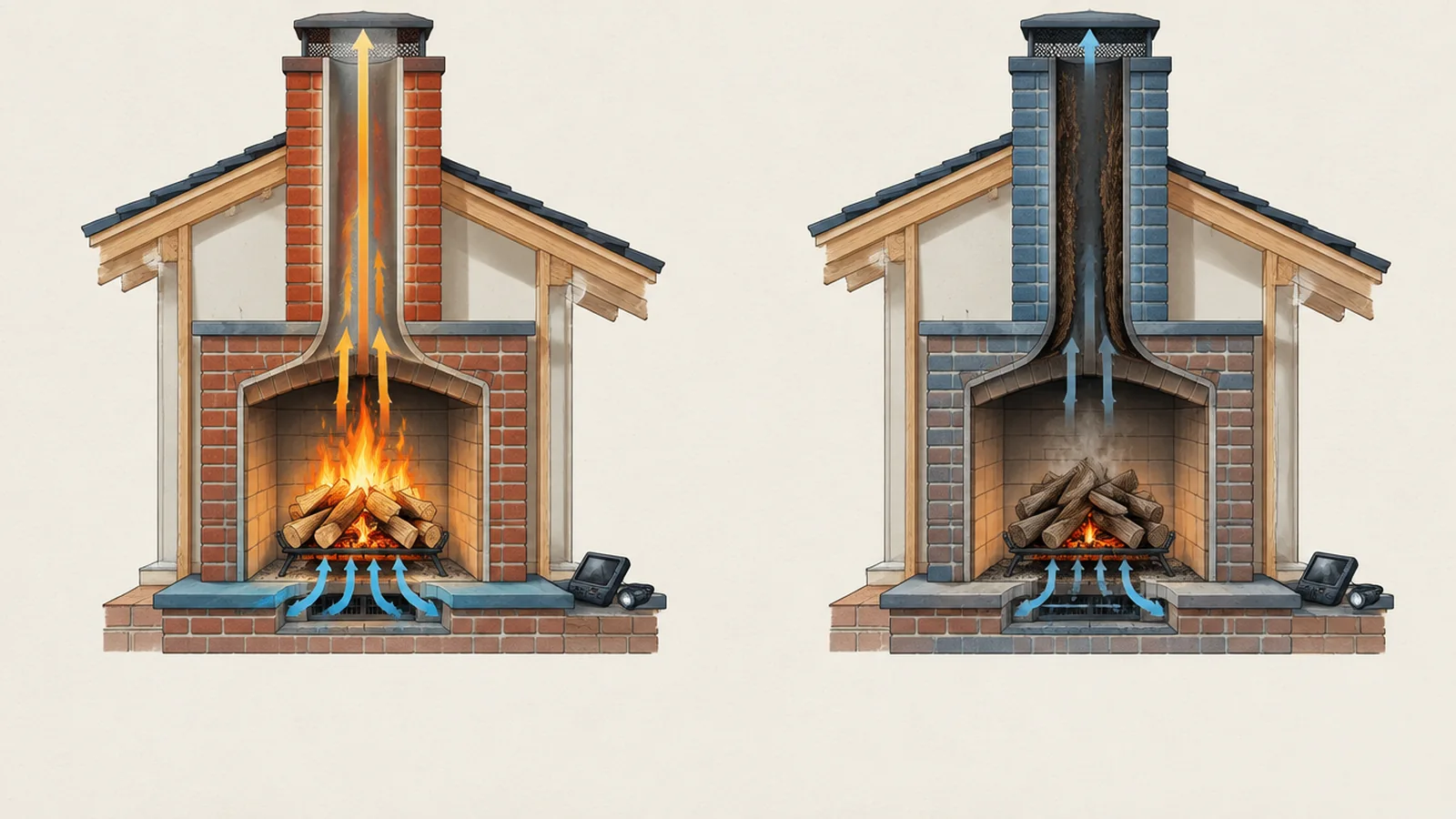
- Drier fuel + clear airflow + hotter flue
- Damp fuel + restricted airflow + cooler flue
EPA’s historical Burn Wise guidance identifies restricted air supply, unseasoned wood, a cooler-than-normal chimney, and overloading a wood-stove firebox as conditions that encourage creosote. EPA now labels the Burn Wise site as a historical record, but those combustion concepts remain useful context.
- Frequent or primary-heat use can add deposits more quickly than occasional ambiance fires.
- Wet or unseasoned wood produces more smoke and can encourage more creosote.
- A low, smoldering fire or restricted air can send more unburned material into the flue.
- A cooler flue can encourage smoke components to condense on its interior surface.
- A new or changed appliance may need closer early checks until its actual pattern is understood.
- A previous inspection showing meaningful mid-season buildup is evidence for checking sooner next time.
Manufacturer guidance can be more frequent than an annual reminder. For example, Regency’s current wood-fireplace maintenance guide advises checking the chimney and connector at least every two months during the heating season and describes closer cleaning attention during the first year. That is a manufacturer example, not a rule for every system; use the instructions for your actual model. The creosote guide explains how these combustion and cooling conditions create different deposit forms.
Is once per cord or after a certain number of fires reliable?
No universal cord count or number of fires can tell you when every chimney needs cleaning. Two households can burn the same amount of wood and create different deposits because the fuel moisture, appliance, airflow, burn rate, flue temperature, and chimney configuration are different.
Approximate use is still useful history. Tell the professional whether the system provides primary heat or occasional ambiance, how much wood you use, whether the wood is seasoned, and whether your operating pattern changed. That context helps interpret what the inspection finds; it does not replace the inspection.
Be wary of a recommendation based only on “every cord,” “every 50 fires,” or a fixed number of weeks. Ask what was observed in your flue and whether the recommendation comes from the system manual, a previous accumulation pattern, or a current condition.
When should you schedule another check sooner?
Do not wait for the next routine date when the system changes, gives a warning sign, or has already shown that deposits accumulate before the year is over.
| What changed | Why it matters | What to do |
|---|---|---|
| A professional previously found substantial buildup partway through the season | Your actual system may accumulate deposits faster than an annual-only plan captures | Follow the recommended mid-season check and ask whether the pattern changes after operating adjustments |
| A new or different appliance, fuel, liner, or venting arrangement | The combustion and venting conditions may change | Have the system evaluated for the change and follow its manual |
| The chimney was unused for a long time or its history is unknown | Debris, nesting, deterioration, or earlier deposits may be present | Arrange inspection before regular use |
| Smoke enters the room, draft changes substantially, or debris falls | An obstruction, deposit, venting problem, or physical defect may need investigation | Stop use if conditions are unsafe and arrange prompt evaluation rather than assuming a routine sweep will solve it |
| A chimney fire may have occurred | Cleaning alone cannot establish whether damage is absent | Stop using the system and arrange appropriate professional evaluation before reuse |
| The manufacturer calls for checks during the heating season | The appliance and vent were designed around those maintenance instructions | Use the stated model-specific interval |
An odor, smoke problem, or poor draft can have more than one cause. Cleaning may be part of the remedy, but it does not correct every pressure, sizing, installation, moisture, or structural problem.
What if the inspection says cleaning is not needed?
An inspection can reasonably conclude that sweeping is not presently indicated when the observed deposits, debris, and obstruction do not call for removal. Ask the inspector to identify the system, explain what was visible, and record any access or visibility limits.
CSIA’s Level 1 masonry procedure includes cleanliness and blockage in the inspection and describes cleaning when deposits prevent the liner from being evaluated. That supports a condition-based answer: clean when the material or visibility calls for it, then examine the newly visible area.
Cleaning and inspection answer different questions. The chimney inspection guide explains the broader condition check and its limits. A clean flue can still have liner, masonry, clearance, connection, or concealed-area concerns.
Questions to ask about the next cleaning interval
Use the actual findings to set the plan. These questions help turn a generic annual reminder into a system-specific maintenance interval.
- Which fireplace or appliance, chimney, and flue did you evaluate?
- What deposits, debris, or obstruction did you find, and where?
- Which manufacturer or professional guidance applies to this system?
- Does the current finding call for cleaning now?
- Based on this system’s actual accumulation, should it be checked before the next annual visit?
- Would a change in wood moisture or operating pattern affect the interval?
- What symptoms or events should prompt an earlier call?
- Which areas could not be reached or properly viewed?
Set the interval from the system, not a generic calendar
Use the yearly visit as a reliable checkpoint, then base the cleaning work and any earlier follow-up on the actual fireplace or appliance, its manual, deposits, obstructions, use, operation, and previous findings. That approach is more useful than automatically buying the same sweep every year or waiting for an invented fire-count rule.
Ask the professional to show what supports the recommendation and write down the next check interval. If the reason changes—a new appliance, heavier use, smoke, debris, or a suspected fire—the schedule should change too.
General information, not an inspection or diagnosis. Confirm your situation with a qualified professional.
Sources and further reading
CSIA homeowner resources: annual inspection and condition-based sweeping
U.S. Fire Administration: Heating fire safety
CPSC: Home heating equipment and yearly professional inspection
EPA Burn Wise: Wood-burning appliance questions (historical program record)
Regency: Wood fireplace maintenance guide
CSIA Level 1 masonry chimney inspection procedure (2019 PDF)