
What Is Creosote?
Creosote is combustible residue that forms when some compounds in wood smoke cool and stick to the inside of a chimney. It can look flaky, sticky or tar-like, or shiny and hardened—and more than one form can be present in the same flue.
| Deposit description | What it may mean | What to ask |
|---|---|---|
| Loose or flaky deposit | Often more responsive to ordinary mechanical sweeping | Where is it, and how much remains after cleaning? |
| Sticky or tar-like deposit | May need a different professional treatment and removal plan | Why is ordinary brushing insufficient? |
| Shiny, hardened glaze | Dense deposit that can be difficult to remove | What method is proposed, and how will the result be checked? |
| Soft soot or ash | Not every black deposit is identical creosote | What material is it, and which parts of the system contain it? |
Do not try to identify the entire flue from what you can see at the fireplace opening. Ask for useful images, the location and texture of the deposit, and the limits of what could be examined.
What is creosote?
Wood does not burn into heat alone. Some gases, droplets, and particles in wood smoke can leave the fire without being fully burned. As that smoke moves into a cooler chimney, compounds can condense and stick to the flue surface as creosote.
CSIA describes this condensation process and the mixture of combustion byproducts that can become residue. EPA’s historical Burn Wise guidance similarly defines creosote as combustible residue formed by wood gases that are not completely burned.
This is not the creosote used to preserve railroad ties
The same word is also used for industrial wood preservatives made from coal tar or wood tar. EPA’s preservative-creosote page covers that separate product context. This guide is about deposits created inside wood-burning venting systems.
How does creosote form inside a chimney?
Formation is a chain: wood burns, smoke carries incompletely burned compounds into the venting system, and cooler flue surfaces allow some of those compounds to condense. Repeated fires can add more material or create different textures in different locations.
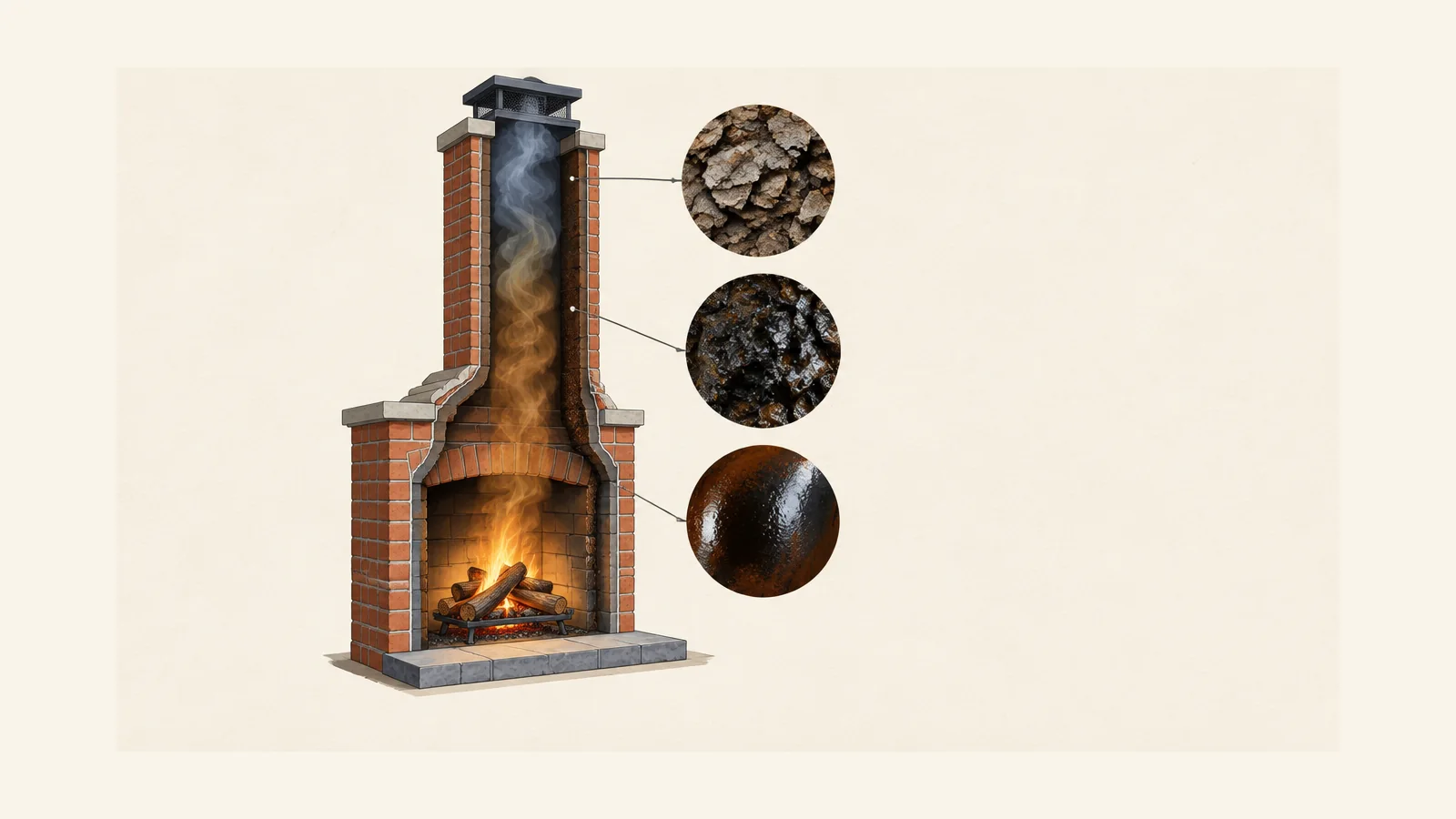
- Smoke compounds rise
- Cooler flue surfaces collect residue
- Deposits can have different textures
The chimney is not a uniform tube at one temperature. Exterior sections, offsets, appliance connectors, smoke chambers, and different firing patterns can create different conditions, which is one reason a single view from below cannot describe the whole system.
Creosote forms in wood-burning systems. Gas and oil appliances can have soot, corrosion, debris, condensation, or venting problems, but a wood-creosote explanation should not be automatically applied to them.
What does creosote look like?
Creosote is often black or brown, but color alone does not identify its texture or removal difficulty. It may be crusty and flaky, sticky and tar-like, or smooth, shiny, and hardened. More than one form can appear in the same chimney.
CSIA’s prevention guidance uses those physical descriptions and notes that several forms can occur together. A professional should describe what was observed rather than treating one photo or one label as a complete diagnosis.
- Loose or flaky material may brush away more readily, but the result still depends on location and access.
- Sticky or tar-like material can adhere to the liner and may not respond to ordinary brushing.
- Shiny, hardened glaze is dense and can be particularly difficult to remove.
- Bubbly, crusty, or layered areas can occur alongside other textures and should be located in the report.
A photo can document an observed surface. It cannot establish what is behind a liner, beyond an obstruction, or outside the camera’s path.
Creosote, soot, and glaze: what is the difference?
These words can overlap in everyday use, so ask the professional to describe the material itself. The practical distinction is its composition, texture, location, and how it responds to removal—not which dramatic label appears on an estimate.
| Term | Plain-language description | Why the distinction matters |
|---|---|---|
| Soot | Soft carbon particles that may be mixed with ash | It can look black or brown but is not automatically the same deposit as hardened creosote |
| Creosote | Combustible wood-smoke deposit that can be hard, flaky, bubbly, sticky, or tar-like | Texture and location affect the removal plan |
| Glaze | Dense, shiny or tarry wood-burning deposit | It can resist ordinary brushing and may require a different professional process |
The third edition of CSIA’s Homeowner’s Guide separates soot, creosote, and glaze as deposit categories. Other sources use “creosote” broadly enough to include glazed creosote. Ask for the observed form so terminology does not hide the actual condition.
Why does creosote matter?
Creosote is combustible material inside the venting path. If enough deposit is present and conditions ignite it, it can fuel a chimney fire. Buildup can also cover the surface an inspector needs to evaluate.
CSIA and EPA’s historical guidance both describe the deposit as combustible. The risk is why a professional should identify buildup and explain whether cleaning is needed rather than waiting for a homeowner to see it from the room.
Finding creosote does not prove that a chimney fire has already happened, and removing it does not prove every liner, connection, masonry area, or concealed clearance is sound. Cleaning removes suitable material; inspection evaluates condition within a defined scope.
If a chimney fire may have occurred, stop using the system and arrange appropriate professional evaluation before reuse. The chimney inspection guide explains how findings and limitations should be documented.
What makes creosote build up faster?
No single wood species, number of fires, or calendar interval predicts buildup. Fuel moisture, combustion air, burn pattern, chimney temperature, appliance design, use, and the system’s previous accumulation all matter.
- Restricted combustion air can leave more smoke compounds unburned and keep smoke in the flue longer.
- Wet or unseasoned wood uses heat to drive off water, producing cooler, smokier combustion.
- A cooler chimney encourages smoke compounds to condense on the flue surface.
- Low, smoldering burns and overloading a stove for a longer burn can increase smoke and deposits.
- Frequent use can add material faster, while the same amount of wood can produce different results in different systems.
EPA’s wood-moisture handout says wet wood produces less heat and more smoke and creosote. CSIA also identifies restricted air, unseasoned wood, and cooler chimney temperatures as buildup factors.
Does pine cause creosote?
A species name by itself is not a reliable explanation. How dry the wood is and how it burns in the actual appliance and chimney are central factors. Ask about fuel moisture, airflow, operating pattern, and the observed deposit instead of accepting “you burned pine” as the whole diagnosis.
For a system-specific schedule, use the chimney-cleaning frequency guide.
Does an efficient wood stove prevent creosote?
No wood-burning appliance should be treated as creosote-proof. A more efficient stove can burn more smoke compounds and may create less buildup than an older, less efficient appliance, but installation, fuel, operation, venting, and maintenance still matter.
EPA’s historical Burn Wise FAQ says certified wood stoves generally produce less creosote than older non-certified models, while still recommending professional inspection and cleaning. Follow the owner manual for the actual appliance and chimney.
A new appliance can also change flue-gas temperature, connector configuration, and venting requirements. Have the complete system evaluated when the appliance, fuel, liner, or venting arrangement changes.
Can ordinary sweeping remove all creosote?
Not always. The result depends on the deposit’s texture, thickness, location, access, liner or chimney system, and removal method. Loose material and dense glaze should not receive the same proposal.
CSIA’s homeowner guidance says hard or tacky layers may not come off with normal mechanical brushing. Professionals may use an appropriate treatment to change the deposit before mechanical removal, while crusty material may respond to rotary cleaning.
This is not a homeowner treatment guide. Acids, professional chemicals, rotary equipment, roof access, and aggressive cleaning can introduce hazards or damage the system. Ask which method fits the identified material and how remaining deposits and the newly exposed surface will be checked.
For the service visit itself, see the professional chimney-cleaning guide.
Do chimney-cleaning logs or chemicals remove creosote?
A product may help alter or loosen some deposits, but it does not physically remove all resulting material or replace a professional inspection. Debris can remain on a smoke shelf, baffle, catalytic combustor, or offset after it leaves the flue wall.
CSIA states that chemical products alone are not an adequate substitute for mechanical cleaning and inspection. Some products are used by professionals as part of a process for a specific hard or tacky deposit, followed by physical removal and evaluation.
If a product is proposed, ask what deposit it is intended to change, where the loosened material will go, who removes it, and how the professional will verify the result. Do not assume a product label means the chimney is clean or ready to use.
Are “stage 1, 2, and 3” official creosote levels?
The reviewed authoritative sources do not establish a universal formal three-stage creosote classification. Numbered terms may be trade shorthand, but the number alone does not tell you the texture, location, extent, removal difficulty, or effect on inspection visibility.
CSIA’s FAQ quotes a homeowner whose sweep used “level 3,” but CSIA’s response discusses gummy, glazed, and crusty material and the methods that may be used. Its prevention guidance describes physical forms rather than a numbered standard.
- Ask the professional to show where the deposit is.
- Ask whether it is loose, flaky, bubbly, sticky, tar-like, or shiny and hardened.
- Ask what ordinary brushing can remove and why another method is proposed.
- Ask what remains unseen while the deposit is present.
- Ask how the result and newly visible liner surface will be evaluated.
The point is not to argue over vocabulary. It is to make sure the recommendation is tied to an observable condition and a defined result.
What should you ask the chimney professional to show you?
Ask for evidence that connects the deposit description to the service plan. Useful documentation is more specific than “heavy creosote” or a stage number.
- Which fireplace or appliance, chimney, and flue contain the deposit?
- Where in the system is it heaviest, and could other areas not be seen?
- What color and texture did you observe?
- Can you show a useful photo or scan image tied to that location?
- Does the material block inspection of the liner or another surface?
- What removal method is included, and what would require separate authorization?
- How will you remove fallen debris and check the result?
- What fuel, airflow, operation, or system factor might be contributing, and which part is confirmed versus suspected?
If cleaning and inspection are booked together, use Cleaning vs. Inspection to confirm the initial check, authorized cleaning, and post-clean condition review.
Use the deposit description, not just the label
Creosote is combustible wood-smoke residue, but it does not look or behave the same in every chimney. The useful finding names the system, location, texture, extent, visibility limit, and proposed removal method.
Ask to see what was observed and how the professional will verify the work. That gives you a clearer basis for cleaning, inspection, and operating changes than a color, a dramatic photo, or an unexplained stage number.
General information, not an inspection or diagnosis. Confirm your situation with a qualified professional.
Sources and further reading
CSIA: Preventing chimney fires — creosote formation and physical forms
CSIA homeowner resources: chemical-cleaner limits and difficult deposits
CSIA Homeowner’s Guide, third edition: soot, creosote, and glaze (PDF)
EPA Burn Wise: Wood-burning appliance questions (historical program record)