
Level 1 vs. Level 2 vs. Level 3 Chimney Inspections
The inspection level depends mostly on why the chimney is being checked. Routine, unchanged use usually points to Level 1. A home sale, system change, or possible damage often calls for Level 2. Level 3 is targeted access to a concealed area when a specific concern cannot be answered another way.
| Why the chimney is being checked | Likely starting point | What to tell the inspector |
|---|---|---|
| Routine annual check; same appliance, fuel, and use | Usually Level 1 | Mention any smoke, odor, water, debris, or other change you have noticed |
| Buying or selling a home | Level 2 is commonly recommended in CSIA guidance | Identify every fireplace, appliance, chimney, and flue that should be included |
| Changing the appliance, fuel, efficiency, liner, or venting | Often Level 2 when the change is material | Provide the proposed appliance model and describe the planned change |
| Possible chimney fire, impact, malfunction, or damaging weather event | Usually Level 2 first when damage is plausible | Describe the event before cleaning or repair begins |
| A specific concealed concern remains unresolved | Level 3 may be needed | Ask what exact area needs to be opened and what the access should answer |
| Service history is simply unknown | The level depends on the system and circumstances | Share available records and current concerns; unknown history alone does not decide the level |
Use the table as a conversation starter, not a remote diagnosis. The inspector should confirm the level after understanding the system, its use, available access, and the reason for the visit.
What changes between Level 1, Level 2, and Level 3?
The levels change the reason for the inspection, the areas that must be reached, and whether a concealed area needs targeted access. They are scopes for different circumstances—not basic, better, and best packages.
| Level | Best fit | Areas examined | Access and equipment | Main limitation |
|---|---|---|---|---|
| Level 1 | Routine use with no significant change | Readily accessible areas and applicable connections | Ordinary visual access; a camera may be used | The inspection cannot establish the condition of concealed construction |
| Level 2 | A property transfer, material system change, likely damaging event, or question Level 1 cannot answer | Level 1 scope plus broader accessible areas, which can include relevant roof, attic, basement, or crawlspace areas | Ladders and common tools may be needed; CSIA’s procedure includes an internal scan or similar examination | Accessible-area review and a camera still cannot see through solid construction |
| Level 3 | A specific suspected concern cannot be evaluated through Level 1 or Level 2 access | The targeted concealed area tied to that concern | A planned opening or removal may be needed only where access is justified | Findings remain limited to the authorized area, and restoration or further work may be needed |
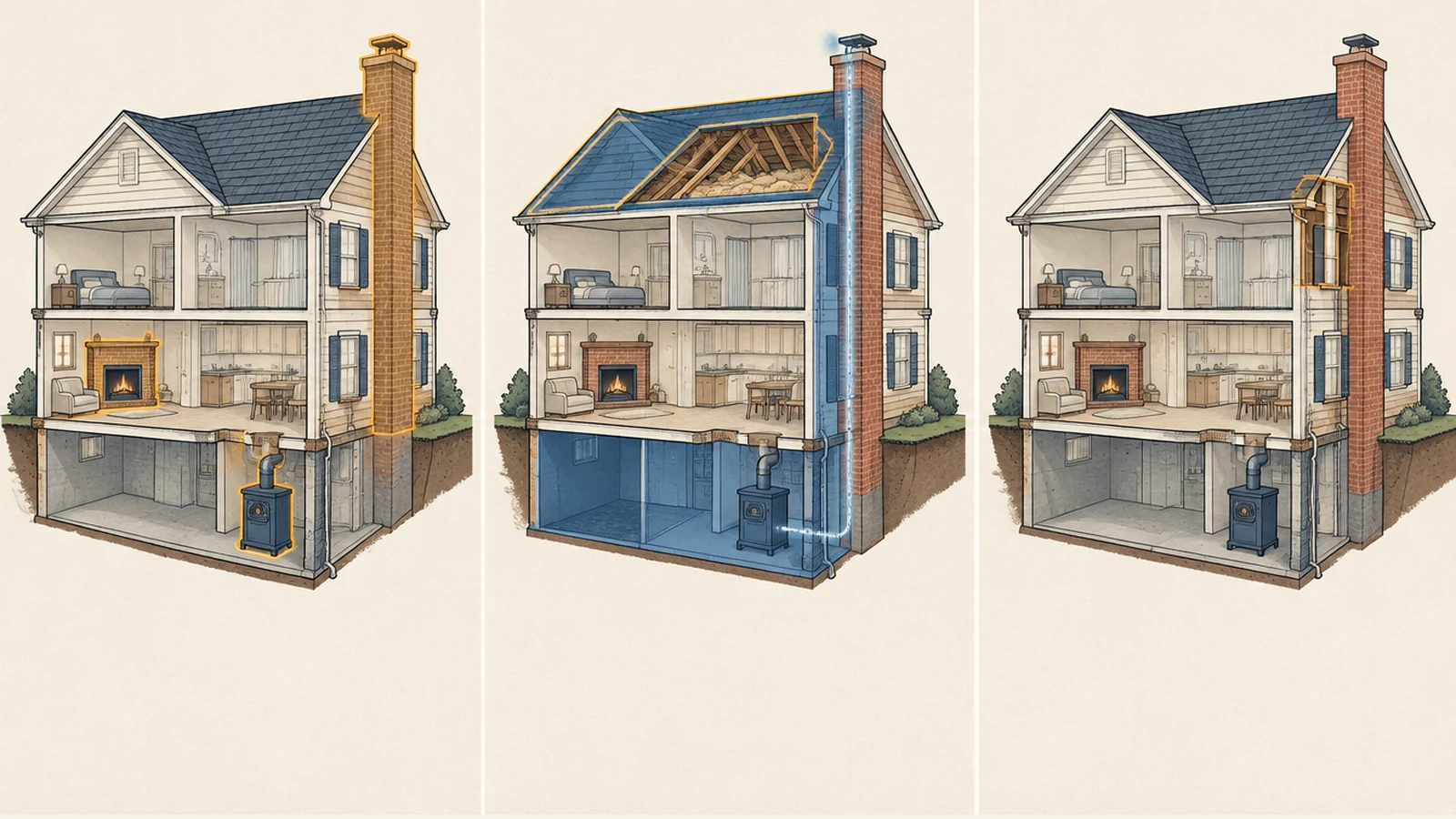
- Level 1: readily accessible
- Level 2: broader accessible areas
- Level 3: targeted concealed access
These practical distinctions follow CSIA’s 2019 Level 1 procedure and Level 2 procedure. They help explain professional practice but should not be treated as quotations from the current NFPA 211 edition. The current NFPA 211 edition is available through NFPA LiNK.
For the broader purpose, preparation, and limits of the visit, see What a Chimney Inspection Checks.
Level 1: the routine, unchanged-use inspection
Level 1 is generally the starting point for a routine check when the appliance, fuel, venting, and way the system is used have not significantly changed. Its limited scope is appropriate to that routine situation; it is not a careless version of a higher level.
CSIA’s Level 1 masonry procedure describes examination of readily accessible portions of the appliance and chimney, along with accessible portions of connected appliances and the chimney connection. It also includes checking for cleanliness and blockage within that scope.
In plain language, readily accessible areas can usually be reached or viewed without a ladder, tools, or removal of a covering. A Level 1 inspection does not involve cutting into a wall, opening a chase, or removing permanent construction.
What to confirm when booking Level 1
- Which fireplace or appliance, chimney, and flue are included?
- Does the company know about every change, symptom, or damaging event that could make a broader scope appropriate?
- Will cleaning be recommended only if deposits or an obstruction make it necessary?
- How will findings and areas that could not be examined be documented?
Level 2: broader accessible areas and internal imaging
Level 2 is generally used when the situation asks more of the inspection: a property transfer, a material change to the appliance or venting, an event likely to have caused damage, or a concern that Level 1 cannot answer.
The CSIA Level 2 masonry procedure describes Level 1 work plus broader accessible areas. Depending on the system and safe access, those areas can include the roof, attic, basement, crawlspace, chimney exterior, appliance connections, and flue interior. It also calls for internal video scanning or a similar examination. If the trigger is a purchase, use the chimney inspection home-buying checklist to define timing, records, and report questions.
Accessible does not mean that every space must be reachable under every condition. A ladder or common hand tool may be needed, but permanently attached construction is not opened as part of ordinary Level 2 access. An unsafe roof, standing water, a blocked access panel, or a space the inspector cannot enter should be named as a limitation.
A change should be described, not reduced to one label
Tell the inspector whether the proposed appliance differs in fuel, type, efficiency, output, connector, liner, or venting arrangement. A like-for-like replacement is not the same question as converting fuels or installing a different appliance. The actual system and applicable instructions still determine what must be evaluated.
For factory-built systems, the listing and manufacturer instructions matter. CSIA’s factory-built Level 2 procedure treats those system details as part of the inspection context rather than assuming masonry-chimney rules apply unchanged.
Level 3: targeted access to a concealed concern
Level 3 may be considered when the inspector has a specific reason to suspect a problem and Levels 1 and 2 cannot expose the area needed to evaluate it. It is targeted access—not a routine premium package and not permission to dismantle unrelated parts of the house.
CSIA’s historical explanation of the inspection levels describes the core idea: access to a concealed area is tied to a suspected hazard that cannot be evaluated at the lower levels. Because that public explanation is historical, use it to understand the concept rather than as a substitute for current standard text or local requirements.
Before concealed access begins
- Ask the inspector to show or describe the finding that created the concern.
- Ask what exact area must be opened and what question the opening should answer.
- Confirm who will remove the material, protect the room, and restore the area afterward.
- Set a stopping point if the first opening does not expose the suspected condition.
- Keep the access plan, authorization, findings, and remaining limitations in writing.
A small planned opening can still be consequential. The homeowner should understand the location, purpose, likely restoration work, and possibility that another step may be needed before authorizing it.
What do readily accessible, accessible, and concealed mean?
These terms describe physical access. They help explain why two inspections of the same chimney can involve different spaces and equipment.
| Term | Practical meaning | Examples | What it does not promise |
|---|---|---|---|
| Readily accessible | Generally reachable or viewable without ladders, tools, or removing a covering | Firebox, exposed appliance surfaces, visible connection areas | A view behind panels, walls, liners, or other barriers |
| Accessible | Generally reachable through normal building access, sometimes with a ladder or common tools to open or move a panel or door | Relevant roof, attic, basement, crawlspace, cleanout, or service-panel areas when safe and available | Cutting permanent construction or entering an unsafe space |
| Concealed | Hidden behind or within permanent construction or another barrier | A framed chase, wall cavity, liner exterior, or covered clearance area | Visibility from a standard camera scan inside the flue |
Even an area that is normally accessible can be unavailable on the day of the inspection. The useful report does not hide that fact; it identifies the area, explains why it was not examined, and says what would be needed to address the limitation.
Does a camera make an inspection Level 2?
No. A camera is a tool, not an inspection level. The reason for the visit, the areas examined, the access used, the connected system, and the documented limits all matter.
CSIA’s dated Level 1 procedure says video scanning may be used at Level 1, while its Level 2 procedure includes internal video scanning or a similar examination. Adding a camera to a routine visit therefore does not automatically supply the rest of a Level 2 scope.
A camera can show the interior surface within its path and line of sight. It cannot see behind a liner, through a masonry wall, into a framed chase, or beyond an obstruction. Ask which flues will be scanned, whether still images or video are included, and what prevented a complete view.
If deposits cover the surface, cleaning may be needed before part of the inspection can be completed. Use Cleaning vs. Inspection to understand that sequence and what a bundled quote should include.
What can remain unseen at every level?
Every inspection has boundaries. Physical barriers, deposits, bends, unsafe access, weather, locked or blocked areas, and the selected scope can keep part of a system from being evaluated.
No level guarantees that every defect will be discovered. Level 2 adds broader accessible areas and interior imaging, but it does not make solid construction transparent. Level 3 can expose one justified concealed area, but it does not establish the condition of every other hidden space.
The report should make those boundaries understandable. Ask which flues and connected appliances were included, which areas were reached, which could not be reached or viewed, and how each limitation affects the conclusion.
A recommendation should follow from an observation
Ask the inspector to show the affected area and explain what is observed, what is suspected, and what another step would answer. If a liner concern is documented, the chimney liner guide can help you compare repair and relining questions without assuming the most extensive option is necessary.
Questions to ask if Level 2 or Level 3 is recommended
A higher level should answer a stated question. Use these prompts to make the reason, scope, and limits concrete before work begins.
- What event, change, symptom, or finding makes this level appropriate?
- Which fireplaces, appliances, chimneys, and flues are included?
- Which roof, attic, basement, crawlspace, chase, or exterior areas will be examined?
- Which flues will be scanned, and will the report include useful images?
- What might remain unseen even after this inspection?
- If Level 3 is proposed, what exact area will be opened, by whom, and who restores it?
- What finding would cause the work to stop, expand, or move to a specialist?
- Will the report separate observed conditions from repair options and estimates?
What should you receive after the inspection?
The findings should identify what was inspected, what was observed, what could not be evaluated, and why any next step is being recommended. The level name alone is not enough.
Ask for the fireplace or appliance, chimney, and flue to be identified; findings tied to a location; photos or scan images where they help; and clear access or visibility limitations. If more inspection, cleaning, testing, or repair is proposed, the report should explain the concern that leads to it.
A repair estimate alone is not an explanation of the inspection findings. You should be able to connect the proposed work to an observed condition, its location, and the limits of what was examined.
Choose the scope by the reason for the inspection
Start with why the chimney is being checked. Routine unchanged use usually fits Level 1. A transfer, material system change, likely damaging event, or unanswered condition question commonly points to Level 2. Level 3 is reserved for targeted access when a specific concealed concern still cannot be evaluated.
Tell the inspector about changes and events before the visit, ask which systems and spaces are included, and keep the stated limitations with the findings. That makes the inspection level useful rather than just a number on an invoice.
General information, not an inspection or diagnosis. Confirm your situation with a qualified professional.
Sources and further reading
NFPA LiNK: NFPA 211, 2027 edition
CSIA Level 1 masonry chimney inspection procedure (2019 PDF)
CSIA Level 2 masonry chimney inspection procedure (2019 PDF)
CSIA Level 2 factory-built chimney inspection procedure (2019 PDF)
CSIA explanation of the three inspection levels (2000 historical overview)