
Chimney Inspection When Buying a Home
A general home inspection may look at the fireplace and visible chimney, but it may not include an internal flue scan or the broader chimney-specific scope commonly associated with a Level 2 inspection. Before closing, check exactly what was included and leave time for a separate chimney inspection if needed.
| Your situation | Practical next step | Confirm in writing |
|---|---|---|
| The home inspection has not happened | Ask how fireplaces and chimneys are covered and whether internal imaging is included | Agreement, Standard of Practice, and a sample report |
| The report says “chimney inspected” | Read the scope and limitations instead of relying on the phrase | Flues, appliances, accessible areas, and imaging |
| The property is being sold | Discuss Level 2 scope early enough for follow-up | All flues, connected appliances, accessible areas, and scan |
| Part of the chimney cannot be accessed | Ask what remained unseen and what would resolve the limitation | Reason, effect on the conclusion, and next step |
| The seller provides sweep or repair receipts | Use them as history, then verify present scope and condition | Dates, systems, findings, and completion records |
| The report recommends repair | Ask for the observed condition and location before comparing estimates | Report, useful photos or video, and limitations |
Your purchase agreement, inspection period, disclosure rules, and available remedies depend on the transaction and jurisdiction. Use this guide to define the chimney work, then discuss transaction decisions with the appropriate real-estate or legal professional.
Is a general home inspection enough for the chimney?
Sometimes it provides useful visible findings, but the words “home inspection” do not tell you whether the flue interior, every chimney, or every connected appliance was examined. Start with the signed agreement, the inspector’s Standard of Practice, and the report.
| Question | General home inspection may provide | Dedicated chimney inspection can add |
|---|---|---|
| What is visible? | Readily accessible or visible fireplace and chimney portions within the agreed scope | A chimney-specific review of the identified system and broader accessible areas |
| Was the flue interior examined? | Not necessarily; major home-inspection standards preserve exclusions | Internal imaging when included in the selected chimney-inspection scope |
| Were all flues and appliances included? | Only what the agreement, access, and actual inspection identify | A defined list of fireplaces, appliances, chimneys, and flues |
| What remains unknown? | Areas outside the agreement or not readily accessible | Areas still inaccessible, concealed, obstructed, or outside the named scope |
ASHI’s current Standard of Practice requires inspection of fuel-burning fireplaces, stoves, inserts, chimneys, and vent systems for inspectors who follow it, but does not require inaccessible flue interiors, determining draft characteristics, or moving inserts and stoves.
InterNACHI’s home-inspection standard requires visible and readily accessible portions of fireplaces and chimneys, while excluding the flue or vent system, chimney and flue interiors, and an NFPA-style fireplace and chimney inspection. Actual services can exceed a minimum standard, so ask what your inspector performed.
Why does a home sale commonly point to Level 2?
A property transfer changes the reason for the inspection. CSIA’s published Level 2 procedure recommends Level 2 when a property is being sold and describes broader accessible-area work plus internal imaging.
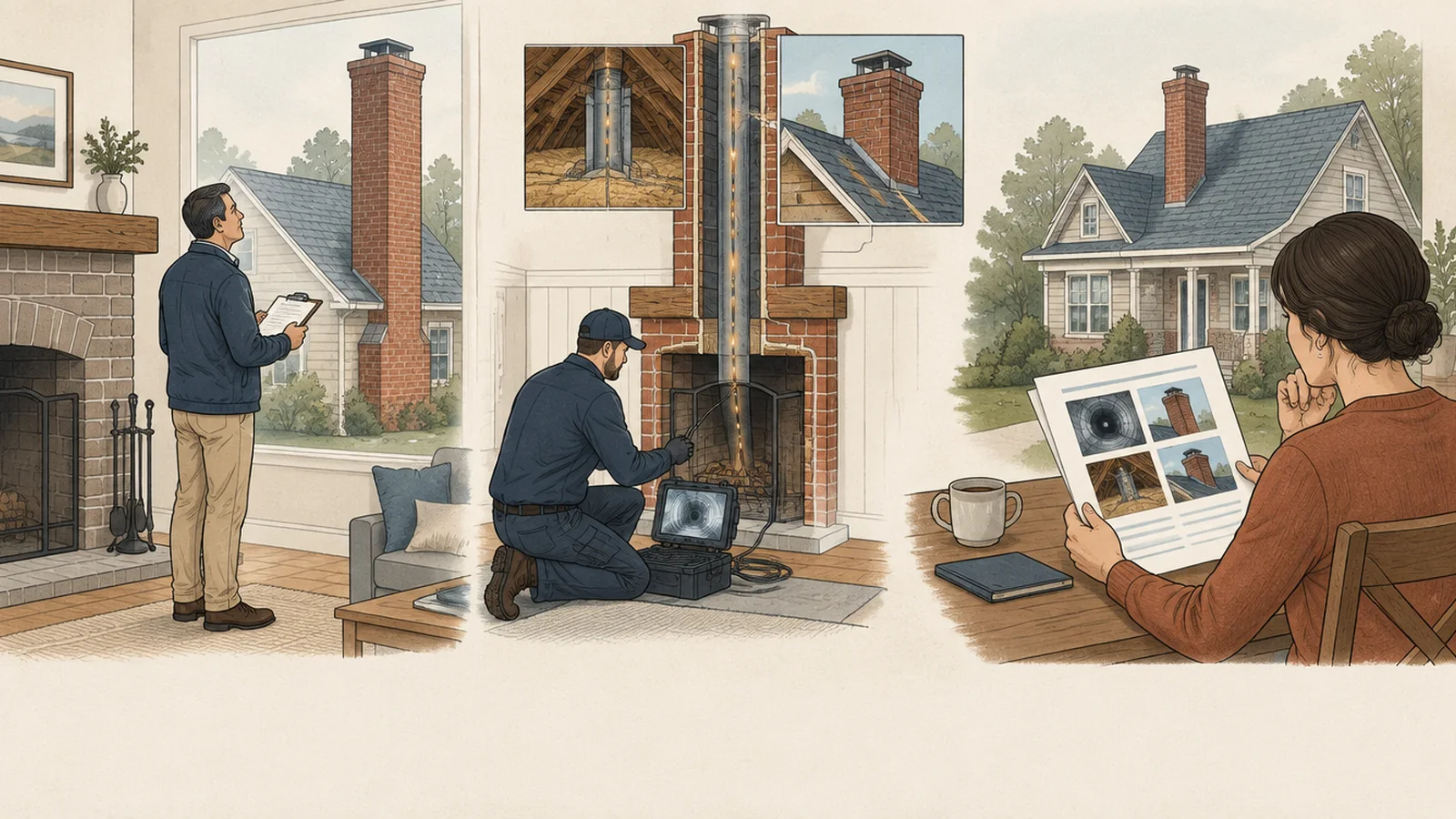
- Check the home-inspection scope
- Complete the chimney-specific review
- Review findings before the deadline
The CSIA Level 2 masonry-chimney procedure says the inspection should include Level 1 work, all flues within the chimney and their connected appliances, broader accessible areas such as relevant roof, attic, basement, and crawlspace locations, and an internal video scan or similar examination.
That document is a 2019 professional procedure referencing NFPA 211 and local-code differences. Treat it as attributed scope guidance, not a statement that every sale legally requires Level 2. The inspection-level comparison explains how Level 2 differs from Level 1 and Level 3.
A camera alone does not prove Level 2
Ask which flues were scanned, which accessible spaces were examined, which connected appliances were included, and what could not be reached. A camera can show the interior surface within its path; it cannot see through a liner, wall, chase, or other solid construction.
What should you ask before booking?
Define the appointment while there is still time to act on the findings. The service name and price are not enough to compare two proposals.
- Which fireplaces, stoves, inserts, appliances, chimneys, and flues are included?
- Are you performing Level 2, and why does that scope fit this property transfer?
- Which flues will receive internal imaging, and will I receive useful still images or video?
- Will you examine relevant accessible roof, attic, basement, crawlspace, chase, and appliance-connection areas?
- What access or weather conditions could prevent part of the inspection?
- If deposits hide the liner, is cleaning included, separately authorized, or scheduled later?
- When will I receive the written report, images, limitations, and recommended next steps?
- Do you have experience with this fireplace, appliance, chimney, and fuel type?
If the home inspector also offers a dedicated chimney service, that may be convenient. Confirm the chimney scope separately rather than assuming it was included in the general inspection.
What records should you request?
Ask for records that identify the system and its history. They can help the inspector understand previous work, but they do not replace current findings.
- Previous chimney and fireplace inspection reports, including photos or scan files
- Cleaning invoices that identify the fireplace, appliance, chimney, or flue serviced
- Repair proposals and completion records rather than estimates alone
- Liner, fireplace, stove, insert, or venting installation records and permits where applicable
- Manufacturer, model, listing label, installation manual, and warranty information
- Records of a known chimney fire, smoke event, appliance change, relining, leak, storm, or structural work
A receipt can show that a service was billed on a date. It does not automatically show which flue was inspected, whether the interior was scanned, what limitations applied, or the system’s present condition. Match each record to the actual appliance and flue.
When should the chimney inspection happen?
Schedule it early enough to receive the report and complete any justified follow-up within your own transaction deadlines. Waiting until the last day leaves little room for cleaning that improves visibility, another specialist, or access that must be arranged.
The Consumer Financial Protection Bureau advises scheduling an independent home inspection as soon as possible so there is time to resolve problems and complete additional inspections. It also suggests attending when possible so you can understand the findings and ask questions.
HUD’s home-inspection notice similarly tells buyers to ask a prospective inspector for the Standard of Practice or a sample report. That is useful before booking because it exposes scope differences while time remains to arrange another service.
Ask your real-estate agent or attorney which dates control your inspection, notice, follow-up, and decision process. This page cannot determine your contractual rights, the seller’s obligations, or which remedy is available.
What if the roof, flue, attic, or another area is inaccessible?
An inaccessible area is an inspection limitation. It is not evidence that the area is sound, and it is not proof that a defect exists. The report should identify the area, say why it could not be evaluated, and explain how that affects the conclusion.
| Limitation | Ask the inspector | Possible next step |
|---|---|---|
| Unsafe roof or weather | Which exterior and termination details remained unseen? | Return under safe conditions or use another justified access method |
| Deposits or obstruction block the view | Can the liner be evaluated without removal? | Authorize appropriate cleaning or obstruction removal, then inspect the newly visible surface |
| Locked, blocked, or stored-over access | Who can make the space safely available? | Arrange access within the transaction timeline |
| Insert, chase, wall, or other construction conceals an area | Is there a specific observed concern, or only a normal concealed boundary? | Document the limit; consider targeted further evaluation only when justified |
Do not climb onto the roof, move a heavy insert, dismantle venting, or open construction yourself. Ask what qualified person and authorization would be needed for any additional access.
What should the report tell you?
The report should let you connect each conclusion to a system, location, observation, and limitation. A level name, pass/fail label, or repair total alone does not do that.
- The fireplace or appliance, chimney, and flue examined
- The inspection level and the reason it fit the transaction
- Accessible areas examined and important areas not examined
- Whether each applicable flue received internal imaging and any limits to the view
- Observed deposits, damage, deterioration, obstruction, water evidence, or connection concerns with locations
- Useful photos or scan images tied to the written finding
- Whether the system should remain unused while a concern is evaluated
- The specific reason for cleaning, further inspection, testing, repair, or specialist review
For the larger condition-check framework, see what a chimney inspection checks. Ask the inspector to distinguish what was observed from a cause or repair they only suspect.
What if the report recommends cleaning or repair?
Start with the finding, not the estimate. Ask the inspector to show the affected area, explain the concern, and identify what the proposed next step should answer or correct.
If deposits prevent a useful view, cleaning may need to happen before the inspection can be completed. The cleaning-versus-inspection guide explains how to define that sequence and avoid treating a sweep receipt as a complete condition report.
- A liner concern: request the location and evidence, then use the liner repair guide to compare repair and relining questions.
- Damaged brick or mortar: ask whether the issue is localized deterioration, water exposure, or possible movement; see chimney masonry repair.
- Water evidence: ask where the inspector believes water enters and what supports that path; see chimney leak repair.
- Fireplace or appliance damage: identify the component and system before selecting work; see fireplace repair.
How a finding affects price, repairs, credits, contingencies, or closing is a transaction question. Review the evidence with the appropriate inspector, contractor, real-estate professional, attorney, lender, or insurer for your situation.
Questions to answer before the inspection period ends
You do not need to become a chimney expert. You need a clear record of what was checked, what was found, and what remains unresolved.
- Did every fireplace, appliance, chimney, and flue I expect to use appear in the scope?
- Which flues were scanned, and did deposits or geometry limit the view?
- Which roof, attic, basement, crawlspace, chase, or connection areas were inaccessible?
- How does each limitation affect the inspector’s conclusion?
- Does any system need to remain unused pending cleaning, further inspection, or repair?
- Do I have the report, useful images, prior records, and any completion documents?
- If another step is recommended, what exact observation supports it and who is qualified to perform it?
- Do the people advising me on the transaction have the findings before the applicable deadline?
Know what was checked before you inherit the uncertainty
A home inspection can provide valuable chimney observations, but it may not include the interior imaging and broader accessible-area review a buyer expects. Confirm the written scope, arrange chimney-specific work early when needed, and keep access limitations with the findings.
The useful result is not a vague assurance or a repair total. It is a report that identifies the systems examined, shows the important observations, states what remained unseen, and explains the evidence behind each next step.
General information, not an inspection or diagnosis. Confirm your situation with a qualified professional.
Sources and further reading
ASHI current Standard of Practice: fireplaces and fuel-burning appliances
InterNACHI Home Inspection Standards of Practice (revised October 2022)
CSIA Level 2 masonry chimney inspection procedure (2019 PDF)
Consumer Financial Protection Bureau: Schedule a home inspection
HUD/FHA: For Your Protection — Get a Home Inspection (2023 PDF)