
Chimney Liner Repair vs Relining: What’s the Difference?
Repair keeps relying on the existing liner and corrects a defined defect or surface condition. Relining installs a new lining system that becomes the passage carrying exhaust. Existing clay tile may stay around that new system or may be removed.
Updated:
If two estimates use different labels, ask one question first: after the work, what material will actually form the passage that carries the exhaust?
| Scope | Completed result |
|---|---|
| Localized repair | The existing liner remains the vent passage; a defined joint, gap, or accessible area is repaired. |
| Resurfacing | The existing liner remains the substrate; a system-specific treatment covers more of its interior surface. |
| Relining | A new lining system becomes the vent passage; old tile may remain around it or may be removed. |
The right scope still depends on the documented condition, the material left in place, the connected appliance, and the selected product or lining system—not the label on the estimate.
What is each estimate actually offering?
The useful distinction is not patch versus pipe. It is whether the completed job still relies on the existing liner or creates a new passage inside the chimney.
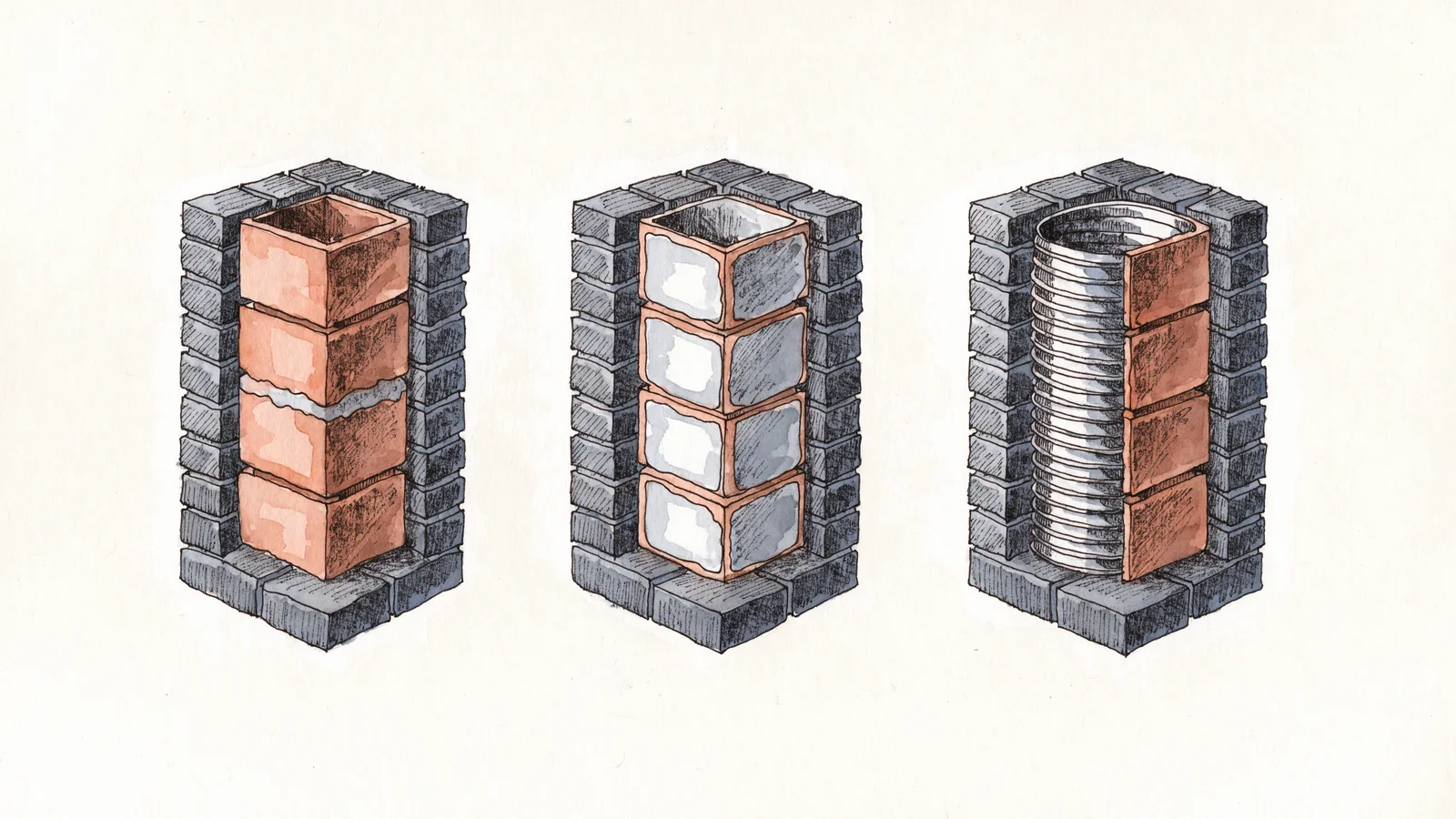
- Localized joint repair
- Resurfaced existing liner
- New lining system
The 2013 HeatShield repair and resurfacing manual illustrates the difference between filling joints and treating a broader surface. Its repair material is not, by itself, a new chimney liner. This is a historical product example, not current approval for a particular installation; ask for the instructions and listing for the exact system proposed today.
The word “replacement” is especially unclear. It may mean installing a new liner inside old tile, removing some or all of the tile first, or rebuilding part of the chimney. The written scope should describe the physical work.
For liner types, inspection methods, sizing, insulation, and the full project, use the complete chimney-liner guide.
What should support a limited repair?
A repair makes sense only if the contractor can explain why the material left in place is suitable to keep relying on.
- The affected flue, defect, location, and visible extent are identified in the inspection findings.
- The remaining clay tile or other substrate is suitable for the named repair system—not merely reachable with an applicator.
- The repaired passage will still suit the connected appliance, fuel, and required vent size.
- The proposal explains preparation, application, verification, and any conditions the repair will not address.
Internal imaging can document visible surfaces, but it cannot establish conditions hidden behind tile or masonry. The CSIA Level 2 masonry-chimney procedure calls for inspection limitations to be documented. See the inspection-level comparison if the evidence behind the recommendation is unclear.
If deposits hide an area, ask how the professional will complete that part of the evaluation after appropriate cleaning. The cleaning-versus-inspection guide explains why removing deposits and evaluating the newly visible surface are separate steps.
Avoid a universal rule such as “one crack can be patched” or “any crack needs a new liner.” Accessibility, surrounding tile condition, cause, product instructions, and the appliance can all change the answer.
When does relining change the job?
Relining makes a new system the exhaust passage. That can address a broader liner problem or provide a passage matched to an appliance, but it also introduces system-specific requirements.
- The existing liner cannot remain the passage relied upon by the proposed repair method.
- The chimney is unlined, or the existing passage is missing, extensively damaged, or incompatible with the intended use.
- The appliance requires a different approved material, size, connection, or venting arrangement.
- The chosen system requires tile removal, access work, insulation, supports, or prerequisite chimney repairs.
For the products in this example, the DuraVent instructions require an experienced installer, appliance-specific venting requirements, and compliance with local building requirements. Ask which instructions, listing conditions, and adopted code apply to the proposed system, including any permit or completion inspection.
The public UL 1777 scope covers specified liners for natural-draft Category I gas, Type L oil, and solid-fuel applications. It excludes Category II, III, and IV gas appliances. A UL 1777 reference alone does not prove that a product suits every appliance or exhaust condition.
Does relining mean the old clay tile must come out?
Not necessarily. Some lining systems can be installed through an existing tile-lined passage when the dimensions and system instructions permit it. Other projects need tile removal or other access work to create room or address conditions that cannot remain.
For example, the DuraFlex installation instructions allow that product to be installed into existing clay tiles or after the tiles are removed. That is a product example, not a rule for every liner.
The estimate should say whether the old tile stays, is partly removed, or is fully removed; what access and debris handling are included; and how the selected liner, any required insulation, and the appliance connection fit the remaining space.
A quote that says only “install stainless liner” leaves out the design of the system. Ask for the product, size, insulation decision, supports, appliance connection, top components, and termination.
How can you compare two estimates?
Compare the completed systems before comparing prices. Ask both contractors to answer the same six questions in writing.
- Which flue and appliance does this proposal serve, and what documented finding does it address?
- What stays, what is removed, and what material forms the finished exhaust passage?
- What exact repair product or lining system is proposed, and where do its instructions cover this use?
- What supports the proposed size and the decision about insulation?
- Which preparation, tile removal, masonry or water-entry repair, connections, termination, access, and cleanup are included?
- How will the completed work and appliance connection be checked, and what records or warranty information will I receive?
Worked example: two proposals, one incomplete finding
This teaching example is not an actual inspection or quote. A report describes open joints in one flue, but deposits prevent evaluation of another area. Proposal A offers joint repair; Proposal B offers a new lining system. Neither label answers what the obscured area contains or why the proposed scope is appropriate.
| Difference in the proposals | Question to resolve it |
|---|---|
| A relies on the existing tile; B supplies a new passage. | What evidence supports keeping or replacing the existing passage, and what still needs examination? |
| One includes deposit removal and a recheck; the other is silent. | Who will complete the obscured part of the evaluation, and how could its findings change either scope? |
| One leaves tile in place; the other includes removal. | Why does that exact system or condition require removal, and are access, debris handling and finishing included? |
Ask both companies to answer the same unresolved questions. Different scopes may be justified, but you need their reasons before deciding whether the totals are comparable. A lower price can omit work; a higher price still needs supporting evidence.
What if the recommendations still conflict?
Request the finding, images, access limits and proposed system in writing. Ask what further evaluation would settle the disagreement, and consider another qualified professional's opinion if the basis remains unclear. The FTC recommends comparing written estimates and asking for an explanation of substantial differences. A second opinion does not cancel an existing instruction to stop using the affected system.
What does liner work not repair?
Repairing or relining a vent passage does not automatically fix the chimney and appliance around it.
A failed crown, flashing, or another water path needs its own diagnosis; use the chimney leak-repair guide. Spalled brick, failed mortar, or movement may require masonry repair before or alongside liner work.
A changed or damaged fireplace or appliance may also require separate fireplace repair or appliance-specific work. Ask the proposal to identify prerequisite work, exclusions, and what happens if concealed deterioration is found after access begins.
Can the chimney be used while you decide?
This page cannot determine whether a specific chimney is safe to use. Ask the inspecting professional for clear written return-to-use guidance tied to the observed condition.
Do not light a test fire to judge a known liner defect. After a suspected chimney fire, disconnected venting, major deterioration, or a finding that compromises exhaust containment, keep the affected system out of use until an appropriately qualified professional evaluates it and required work is completed.
CSIA's after-fire guidance calls for professional sweeping and evaluation before reuse; extinguishing the fire or clearing deposits does not establish that the surrounding system escaped damage.
If the report does not identify the affected flue, visible extent, or inspection limitation, start with the chimney inspection guide before choosing between proposals. You can browse businesses listing chimney liner work, then select your state and city and confirm service at your address, experience with your appliance, and the inspection or repair scope directly.
General information, not an inspection or diagnosis. Confirm your situation with a qualified professional.
Sources and further reading
UL 1777: Public scope for chimney liners, edition 5 (reaffirmed 2024)
CSIA: Level 2 masonry chimney inspection procedure (2019)
SaverSystems: HeatShield repair and resurfacing instructions (2013; historical product example)
DuraVent: Flexible stainless chimney liner installation instructions
FTC: Comparing estimates and choosing a home-improvement contractor