
Tuckpointing vs Repointing: What Does Your Chimney Need?
Technically, repointing removes deteriorated mortar and replaces it. Traditional tuckpointing is decorative joint work that creates the appearance of a fine joint. In everyday contracting, the terms are often used interchangeably—so compare the written scope, not the label.
| Term | Technical meaning |
|---|---|
| Repointing | Removing deteriorated mortar from existing joints and installing compatible replacement mortar. |
| Traditional tuckpointing | Decorative joint work that uses a fine contrasting line over a flush mortar joint. |
| “Tuckpointing” on many estimates | Often used as a market synonym for repointing; the written steps must show what is actually included. |
If a proposal says only “tuckpoint chimney,” ask what mortar will be removed, how the joints will be prepared, what replacement mortar will be installed, and which faces and areas are included.
Why do contractors use the words differently?
Trade language and technical preservation language do not always line up. That does not make an estimate wrong, but it does mean the heading cannot tell you the scope.
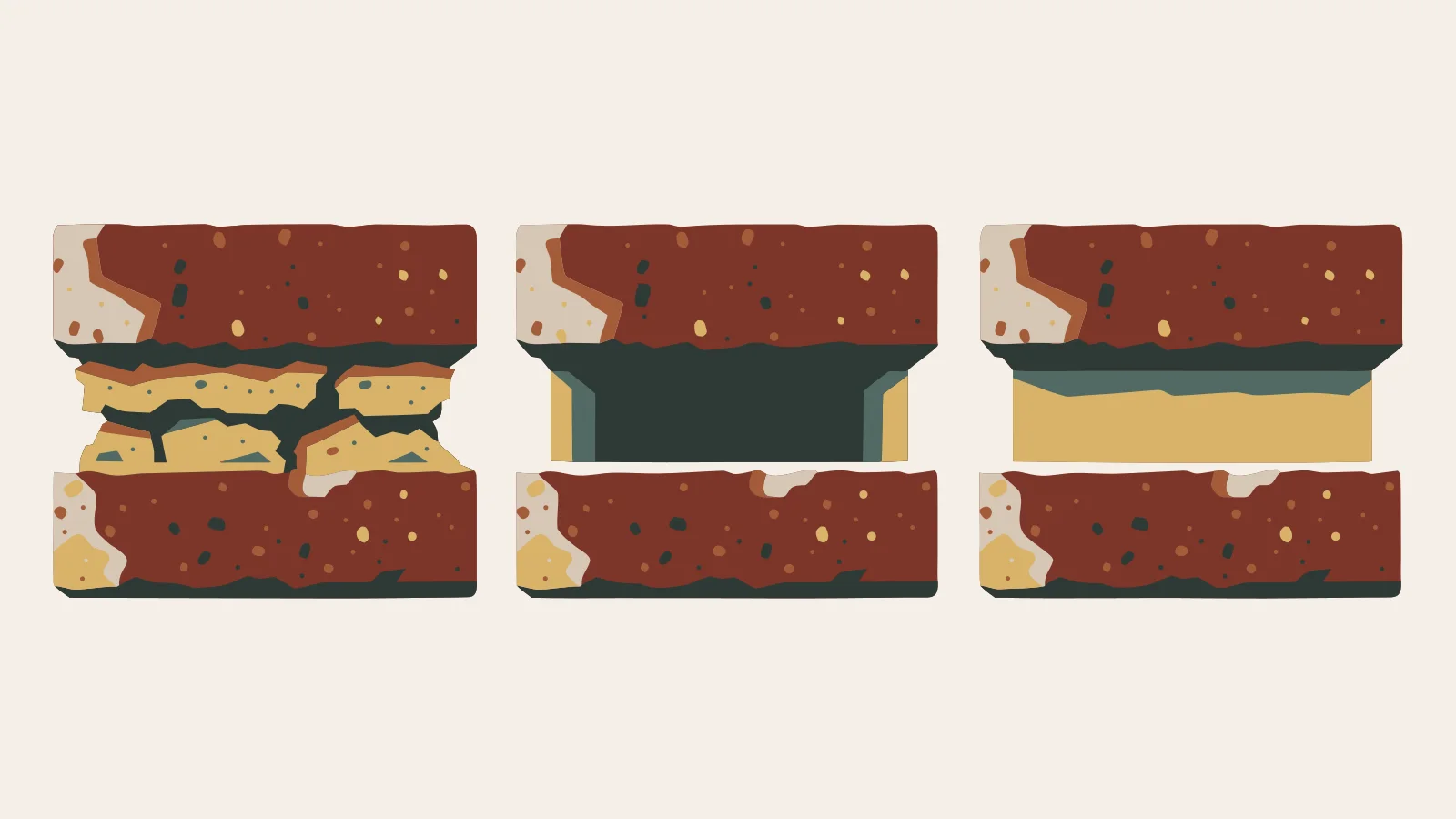
- Deteriorated joint
- Prepared joint
- Replacement mortar
The National Park Service calls repointing the removal and replacement of deteriorated joint mortar and notes that “tuck pointing” is often used inaccurately for the same work. It reserves tuckpointing for a decorative raised line over a flush joint.
The Brick Industry Association also acknowledges that pointing, repointing, and tuckpointing are often used interchangeably. For a homeowner, the practical response is to translate the term into steps, materials, locations, and limits.
For the larger question—whether the problem is mortar, failed brick, a crown, water entry, or movement—use the chimney masonry repair guide.
What should a repointing scope actually describe?
A useful scope begins with deteriorated joint mortar and ends with a prepared, filled, compacted, tooled, and cured joint. The details should fit the existing masonry rather than a universal recipe.
- The chimney faces, elevations, courses, or measured areas included—and whether the work is spot repair or a broader section.
- How deteriorated mortar will be removed back to sound material while protecting brick or stone edges.
- How dust and loose material will be cleared and how the joint will be prepared before new mortar is placed.
- The replacement mortar and why its physical and visual properties suit the existing masonry.
- How mortar will be placed, compacted, tooled, protected from weather, cured, and cleaned.
- What photos, sample work, or completion records will document the result.
The GSA repointing procedure describes careful removal to sound material, clean joint preparation, layered placement where needed, tooling, curing, and cleaning. Those are specification principles—not a single removal depth or cure schedule for every residential chimney.
Ask how the contractor will determine the necessary depth on this chimney. A fixed online number cannot account for joint size, material condition, stability, tools, or the applicable project specification.
Is spreading new mortar over the joint the same repair?
No. A thin surface covering does not remove the deteriorated material beneath it or create the prepared joint described in repointing guidance.
The GSA repointing procedure rejects shallow or feather-edged joint work, while International Masonry Institute guidance emphasizes removing deteriorated mortar so the replacement can bond within a sound joint. The proposal should state the removal and preparation—not merely promise a fresh appearance.
A finished photo can show color and tooling, but it cannot prove how the joint was prepared. For substantial work, request progress photos after deteriorated mortar is removed and before the joints are refilled.
This distinction is not a reason to reject every localized repair. A limited area can be a legitimate scope when the estimate identifies the affected joints and explains why adjacent material can remain.
Why does the replacement mortar matter?
The strongest mortar is not automatically the best mortar. The replacement has to work with the existing brick or stone as the assembly gets wet, dries, heats, cools, and moves.
The NPS preservation brief explains that replacement mortar should match relevant physical properties as well as appearance. An incompatible hard or dense mortar can place damaging stress on softer masonry or change how moisture leaves the wall.
IMI's restoration guidance likewise emphasizes compatibility with the masonry units and system. This page cannot select a universal mortar type for a chimney based on age or appearance alone.
Ask what supports the proposed mortar selection. For older, unusual, or previously repaired masonry, that may include examination of sound original mortar, project history, testing, and a sample or mock-up.
What will repointing not fix?
Repointing renews mortar joints. It does not replace missing brick material, stabilize active movement, rebuild a failed crown, or identify and correct every water-entry path.
- Spalled, cracked, or loose brick may need unit repair or replacement; see chimney masonry repair.
- A leaning stack, displaced courses, or cracks that repeatedly reopen need assessment beyond ordinary joint work.
- Failed flashing, crown details, or another unresolved water path may need separate chimney leak diagnosis.
- Exterior joint work does not establish the condition of concealed masonry, the flue liner, or appliance venting.
Ask the estimate to list exclusions and prerequisite work. If two contractors are responding to different assumed causes or extents, their totals are not yet comparable.
How can you compare two tuckpointing or repointing estimates?
Give both contractors the same six questions. The answers should reveal whether they are pricing the same work.
- Which exact joints and chimney faces are included, and what documented condition supports that extent?
- What mortar is removed, how is the required depth determined, and how are adjacent units protected?
- What replacement mortar is specified, and why is it compatible with the existing masonry?
- What joint profile, color, texture, sample, placement, tooling, curing, and cleanup are included?
- Which brick replacement, crown, water-source, access, scaffold, roof-protection, and movement work is included or excluded?
- What before, preparation-stage, and completion documentation will you receive?
If an estimate cannot answer those questions, ask for clarification before comparing price or warranty. A precise scope protects both the homeowner and the contractor from assuming different meanings for the same word.
If the extent is uncertain or the chimney has interior concerns, begin with an appropriate chimney inspection and make sure the report states its access and visibility limitations.
General information, not an inspection or diagnosis. Confirm your situation with a qualified professional.
Sources and further reading
National Park Service: Preservation Brief 2, Repointing Mortar Joints (1998)
International Masonry Institute: Repointing Masonry Walls (2002)
Brick Industry Association: Technical Note 46, Maintenance of Brick Masonry (2017)
International Masonry Institute: Restoration and mortar compatibility
U.S. General Services Administration: Repointing Historic Masonry
Brick Industry Association: Repointing (Tuckpointing) Brick Masonry