
Masonry vs Factory-Built Fireplace: How Can You Tell?
A masonry fireplace is built on site from masonry components. A factory-built fireplace is a listed manufactured assembly installed with specified chimney or vent parts. Brick facing—or brick-pattern panels inside the opening—does not prove which one you have.
| Masonry fireplace | Factory-built fireplace |
|---|---|
| Site-built firebox, smoke chamber, and masonry chimney/flue assembly | Manufactured firebox installed as part of a listed system |
| Repair materials are selected for the existing masonry construction | Panels, chimney sections, doors, and accessories may be model-specific |
| Masonry condition and geometry support the repair decision | Rating plate, manual, listing, and manufacturer instructions support the repair decision |
The practical question is not whether the opening looks traditional. It is whether the fire-containing and venting system was built in place or assembled from a tested manufactured system.
Why can the visible fireplace be misleading?
The decorative surround can hide the construction behind it. A metal factory-built firebox may be framed with brick or stone, while molded refractory panels can resemble laid firebrick.
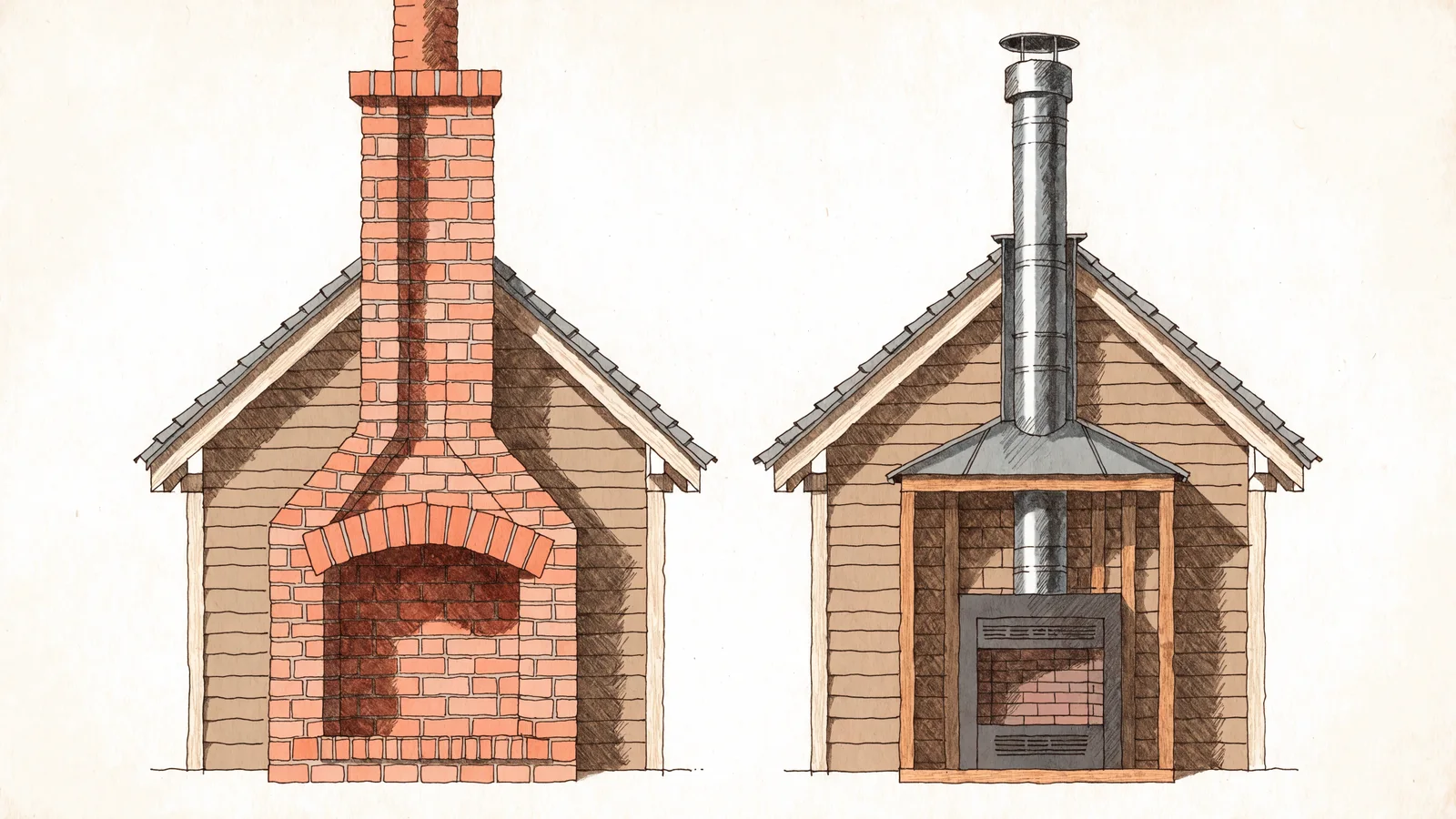
- Site-built masonry system
- Listed manufactured system
The IRC separates masonry and factory-built fireplace provisions. Masonry construction follows site-built requirements, while a factory-built fireplace must be listed, labeled, and installed under its listing.
UL 127's public scope describes a factory-made fire chamber, chimney, roof assembly, and related parts assembled in the field. That solid-fuel scope should not be stretched to cover every manufactured gas or electric fireplace.
Age is not decisive either. Both types have existed for decades, and remodeling can conceal original materials or add a new appliance inside an older opening.
What clues can identify a masonry fireplace?
A conventional masonry fireplace is built as an assembly of masonry parts rather than installed as one manufactured firebox.
- Individual firebrick and mortar joints forming the firebox rather than removable molded panels.
- A site-built throat and masonry smoke chamber above the opening, considered with the rest of the assembly. A damper by itself does not identify a masonry fireplace; factory-built models may also have one.
- A masonry chimney containing a clay, metal, or other lining system rather than a lightweight chimney specified with a fireplace model.
- Construction records or inspection findings showing the firebox, smoke chamber, hearth, chimney, and flue as site-built components.
The Brick Industry Association fireplace diagrams illustrate the firebox, throat, smoke chamber, and chimney relationship. They are useful anatomy references, not a template for diagnosing an existing fireplace from one visible detail.
Do not pry mortar, remove firebrick, or enter the chimney to investigate. If the construction is unclear, document what is safely visible and ask an inspector to state both the identification evidence and any limitations.
What clues can identify a factory-built fireplace?
The strongest evidence is a rating plate, model information, installation manual, or recognizable manufactured firebox and chimney components—not a decorative feature by itself.
- A manufacturer, model, serial number, or certification information on a safely accessible rating plate.
- Metal edges, louvers, air-circulation openings, or a sheet-metal firebox behind the facing.
- Removable refractory side, back, or hearth panels with molded brick patterns.
- A lightweight factory-built chimney within a framed chase, with system firestops, flashing, and termination components.
- A manual or parts list tying the fireplace to specific chimney, hearth, door, or accessory components.
CSIA's factory-built inspection procedure uses manufacturer instructions when available and checks refractory panels, sheet metal, hearth, louvers, gaps, clearances, and the accessible chimney connection.
A manufacturer manual may place the rating plate in a control area and use it to identify the unit. The HST48D manual is one model-specific example. Photograph a plate only if it is safely accessible while the fireplace is off and cool; do not remove panels or disassemble the appliance to find it.
A missing or unreadable label creates an identification problem. It does not make generic replacement parts acceptable and does not prove the fireplace is masonry.
How do the chimney and termination differ?
A masonry fireplace commonly vents through a lined masonry chimney. A factory-built fireplace uses the chimney or vent components specified for that system, which may run inside a framed chase.
IRC provisions require factory-built chimneys to follow their listing and manufacturer instructions. The Rutherford installation manual illustrates a defined family of chimney sections, offsets, firestops, flashing, and terminations rather than interchangeable pipe.
At the roof, a masonry chimney may have a crown and rain cap. A framed chase may have a sheet-metal chase cover around the listed chimney and termination. See the crown, chase cover, and cap comparison for those separate components.
Do not classify the fireplace by the roof silhouette alone. Exterior cladding can make a framed chase look masonry, and a masonry chimney can contain a later appliance vent or liner.
Why does the distinction change the repair?
The same-looking crack or damaged surface can belong to different materials with different approval paths.
- A masonry firebox may need compatible refractory mortar, firebrick replacement, or rebuilding based on the site-built condition.
- A factory-built refractory panel must be evaluated using the model's instructions and compatible-part information; ordinary masonry patching is not automatically suitable.
- A manufactured door, grate, hearth extension, chimney part, or termination may need to be listed or documented for that system.
- Damage behind a visible panel, corrosion of sheet metal, or a disconnected manufactured chimney can change the scope beyond a cosmetic repair.
Physical fit is not compatibility. Ask the estimate to state the fireplace type, manufacturer/model if applicable, failed component, supporting finding, exact repair or part, and the basis for using it.
For detailed crack, panel, damper, smoke, gas-appliance, and water problems, continue to the fireplace repair guide.
Where do gas logs, inserts, and gas fireplaces fit?
Gas describes the fuel. It does not tell you whether the surrounding fireplace is masonry or factory-built.
- A gas log set may be installed only where the existing fireplace, log-set instructions, venting, and local requirements allow it. In a factory-built fireplace, an unvented gas log heater requires the fireplace system to be specifically tested, listed, and labeled for that use.
- A gas insert is a manufactured appliance installed within an appropriate existing fireplace and connected to its specified venting.
- A complete factory-built gas fireplace is its own listed appliance and venting system; it is not a masonry fireplace merely because it has a brick surround.
Identify both layers: the original fireplace or enclosure and any appliance installed inside it. Service may require a hearth-appliance technician, chimney professional, or mason depending on which component failed.
Do not remove glass, rearrange logs or media, bypass a control, or alter venting to identify the system. Use the appliance documentation and qualified service.
What should you gather before booking service?
A few safe observations can prevent the wrong trade or generic part from being scheduled.
- Wide photos of the opening, hearth, surround, and any safely visible metal edges or louvers.
- A photo of an accessible rating plate and its manufacturer, model, and serial number.
- Manuals, installation records, prior inspection reports, and repair invoices.
- Whether the system burns wood, has gas logs, contains an insert, or is a complete gas appliance.
- The symptom, when it occurs, and any written instruction to stop using the fireplace.
- What could not be seen without disassembly, attic access, or roof access.
If identification or condition remains uncertain, arrange an appropriate chimney and fireplace inspection. Ask the report to name the system, chimney or vent, accessible labels, limitations, and any manufacturer documentation used.
Keep the fireplace unused when an inspector or manufacturer has directed that, or when there is substantial smoke spillage, loose firebox material, damaged/disconnected venting, a gas malfunction, or another identified unsafe condition.
General information, not an inspection or diagnosis. Confirm your situation with a qualified professional.
Sources and further reading
2024 IRC, Chapter 10: Masonry and factory-built fireplaces
UL 127: Factory-Built Fireplaces, public scope (2024)
Brick Industry Association: Residential Fireplace Design (1993; historical anatomy reference)
CSIA: Level 1 inspection of a factory-built fireplace (2019)
Heat & Glo HST48D installation manual: identification and system components
Heat & Glo Rutherford installation manual: compatible chimney components